
How to Find an Unstressed Syllable
We’re going to use the word purchase for this demonstration.
“Why isn’t purchase spelled with an <i> instead of an <a>?” A third-grade student wanted to know after misspelling this word. This led to a discussion about how to find an unstressed syllable. But first we talked about meaning.
Meaning First
She is beginning to see that spelling does not always use a default spelling to match pronunciation. I asked her to use the word in a sentence.
She did: “Dad purchased the car.”
Morphology & Word Sums
We talked over some potential word sums to show the structure of the spelling. These are hypothetical to get us thinking about what might be.
purchase + ed or pur + chase + ed
Then we look at the word’s history. Often the etymology, the origin and history of a word, opens our eyes to the meaning behind the spelling.
What Can We Learn from Etymology
Etymonline.com showed us that purchase came into English from an Anglo-French word spelled <purchaser> and before that from Old French: <porchacier>. The Old French version had a meaning of “search for, pursue eagerly.” That made me think of Black Friday and the push and shove that sometimes happens in the pursuit of deals. (Did you catch that connection: pursue and pursuit?)

Reading the entry, we noted that purchase is related to chase. I was not expecting that! But how fitting that term is for what happens during the Christmas gift-buying missions we all go on. I’m always grateful for students’ questions since those very often lead to me learning as well as them.
You have permission to not know everything about every English word. <– This! It’s why so many teachers, tutors, and parents enjoy Structured Word Inquiry so much. We don’t have to be the all-knowing expert–that’s stressful. Instead, we can show our students what life-long learning looks like and that it’s fun! I truly get excited when I learn something about our writing system with a student. And you will too!
Connecting Purchase to a Larger Word Family
Why had I never connected the spelling of <chase> in purchase to relate to chase, chased, chasing? Can you guess the reason I, and maybe you too, had never made that connection even though the spelling is clearly there? Maybe because purchase and chase are pronounced differently. Maybe also because the meaning of purchase has evolved.

Phonology & Unstressed Syllables
How do we pronounce purchase? /pɝ’ tʃəs/ “per chis” sort of, but really it is unstressed. The last vowel is reduced to schwa, as shown in the International Phonetic Association (IPA) with an upside down <e> symbol. These are symbols, not letters. Schwa is the unstressed vowel phoneme, the most common phoneme in English.
Why is <chase> pronounced “chis” or “chus”? It has to do with stressed and unstressed syllables.
In purchase, we enunciate the “pur” with more emphasis. It lasts a little longer in our mouth–that’s the stressed syllable. The last syllable is not enunciated much, has a shorter duration in normal speech, and is pronounced /tʃəs/–that’s the unstressed syllable.
Linguists describe the unstressed vowel as being neutral. I know, I know… for some of us we may feel “purchase” has a /ɪ/ short-I and not a schwa.
But is the second vowel phoneme in that word a clear /ɪ/ vowel phoneme? Compare “sit” to “purchase”. Not the same /ɪ/.
Schwa can feel like a weak /ʌ/ short-u or a weak /ɛ/ short-e or weak /ɪ/ short-i depending on the word. Schwa is always unstressed so it’s not pronounced the same as any stressed vowel phoneme.
An Easy Way to Find the Stressed Syllable
Raise one hand palm down above a desk in front of you. Say the word aloud while letting your hand drop to the desktop. The stressed syllable will be the one you spoke at the moment your hand hit the table. Be sure to say the word naturally without unnatural stretching it out or over-enunciating or overthinking. It can take some practice.
Another method is to Call the Dog. Whatever your word, use it as if you’re calling the dog to come in from the backyard. “Pur–chase”. The syllable that you stretched longer is the stressed syllable. And the ones that receive less time in your mouth are unstressed.

I didn’t learn about this in school. Did you? I learned about it as an adult taking courses from linguists and a speech-language pathologist. But I’m teaching my dyslexic students. Not only does it help them understand a schwa spelling but it’s critical to knowing when to apply the doubling suffixing convention. (There’s a link to the page above with a structured word inquiry at the end of the post.)
Back to the Word Sum
With what we learned from Etymonline.com showing the base as <chase>, we can revisit our hypothetical word sums and determine we can use: pur + chase. The <pur-> prefix having the sense of “forth”-go forward, combining with <chase>.
Purchase in its earlier sense meant –“chasing forward”. That earlier, historical sense is called the orthographic denotation. We can still see a hint of that meaning today. Whether it’s a Black Friday sale or the latest release of gaming console, sometimes buyers are literally chasing forward to get theirs before the item sells out.
Back to the Student’s Question
- Me: “So why isn’t ‘purchase’ spelled with an <i> instead of an <a>,” I asked her.
- Student: “The base is ‘chase’,” she noted.
- Me: “Could we spell it <chise> and make sense with the history and meaning of the word?” I asked.
- Student: “No, we can’t.”
The spelling and meaning connections use phonology with phoneme-grapheme correspondences. But meaning and historical meaning connections drive spelling. English is stress-timed which affects our pronunciation like it does in purchase.
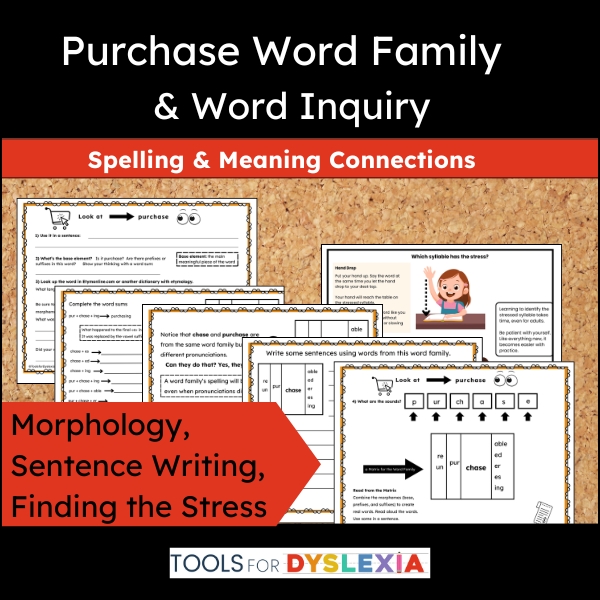
Think about purchase’s connection to chase the next time you’re chasing a deal. Here’s a free print-and-go resource with the <purchase> word family.
Happy Spelling!