

Why Structured Word Inquiry
(This post contains affiliate links. Read my full disclosure.)
What is Structured Word Inquiry?
It’s a research-based method to understand a word’s spelling, meaning, pronunciation. The term, “structured word inquiry,” comes from a 2010 study by Dr. Peter Bowers and Dr. John Kirby to determine how fourth and fifth graders benefit from morphology-based vocabulary instruction.
Okay, so what does Structured Word Inquiry look like in practice? Read on and don’t miss the structured word inquiry resources listed at the end.
At the start of each tutoring session, I ask my student if they have a word they’d like to look at before we do anything else. Maybe it’s a word they read in one of their school subjects or one they misspelled. They also might ask about a word they think has a weird spelling.

Starting with the student’s question sends a powerful message to students. Be curious. Ask questions. Whatever I have planned can wait. Your question is important.
What about this word is interesting or challenging for them? I’ll also ask them to use it in a sentence. Sometimes I help with that. If there are multiple meanings/uses for the word, we review those. Finding out what the student understands or doesn’t understand about the meaning helps us get started on the same page.
Then we look at the morphology (structure) of the word.
Morphology
What’s morphology? Dr. Kelli Sandman-Hurley of the Dyslexia Training Institute explains, “Morphology is the study of the internal structure of a word, which is made up of morphemes. A morpheme is the smallest meaningful unit in a word.” (Dyslexia & Spelling, 2019)
This teaches students to notice, to examine the word’s spelling. Does it have a prefix or a suffix? What might the base be? It’s okay to guess at this point and be wrong and learn. Often those who struggle with reading aren’t looking closely, they might have a tendency to guess based on the first few letters or the word’s shape.
Suppose the word is healthily. Are there prefixes or suffixes on this word? What is the base element, the morpheme that carries the word’s meaning?
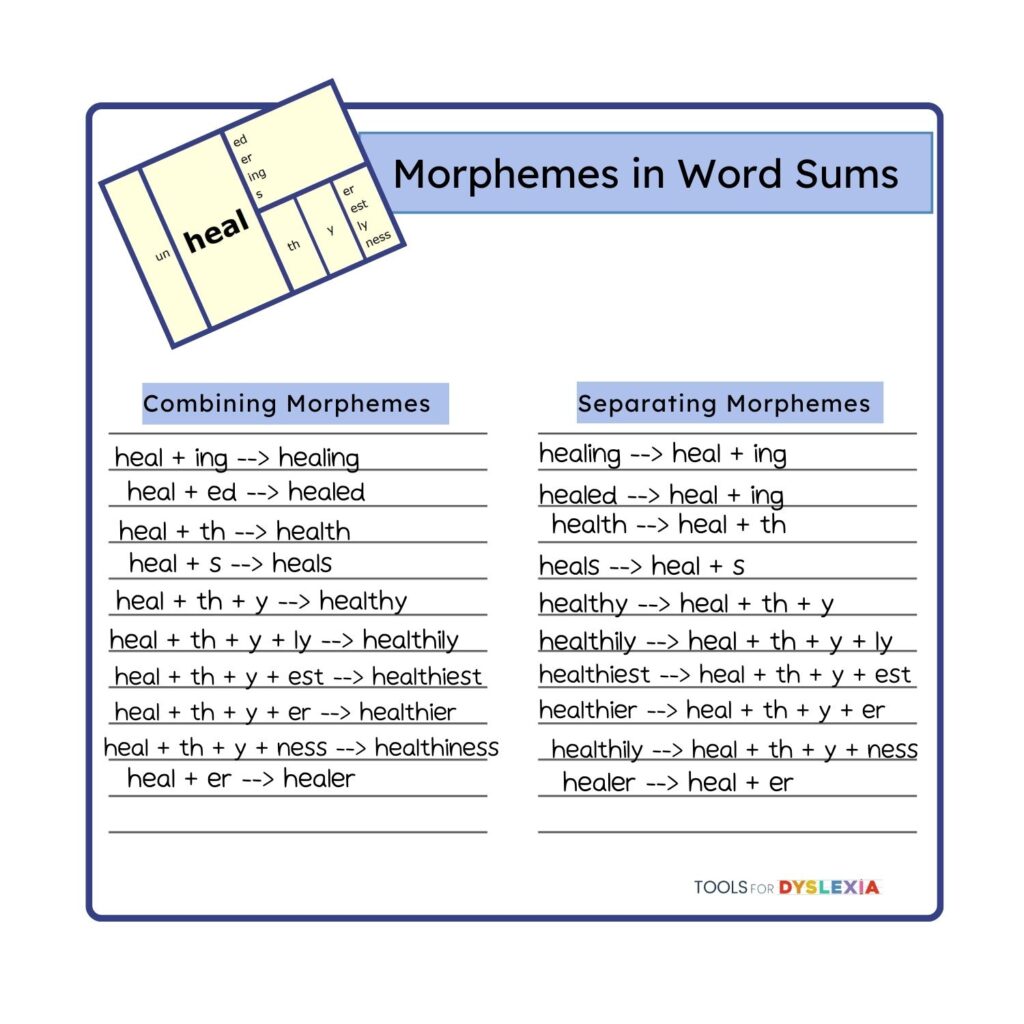
Then we examine the structure of healthy + ly as a word sum. Or we analyze further with health + y + ly or even further with heal + th + y + ly. Sometimes the student notices the connection to healthy from health to heal or poses a question about it.
It’s okay not to analyze beyond healthy + ly.
As we look at the spelling, we’re separating the morphemes and finding the internal structures.
Etymology
Next, we search the online etymology dictionary and maybe a printed etymology dictionary to compare information. So very often the answer to a question about spelling is found in the etymology. As we’re looking, we may notice relatives from the same Latin or Greek root.
It’s beneficial to work with the student to find the word family. Not a rhyming word family like cat, bat, hat, pat, etc. A meaningful word family that you find while adding prefixes and suffixes to a base.
As we look up healthy in Etymonline.com, we find the health and from health we find a <-th> suffix, which leads us on to heal. A question about one word led us to find multiple suffixes and many more words. All of these words are part of the word family.
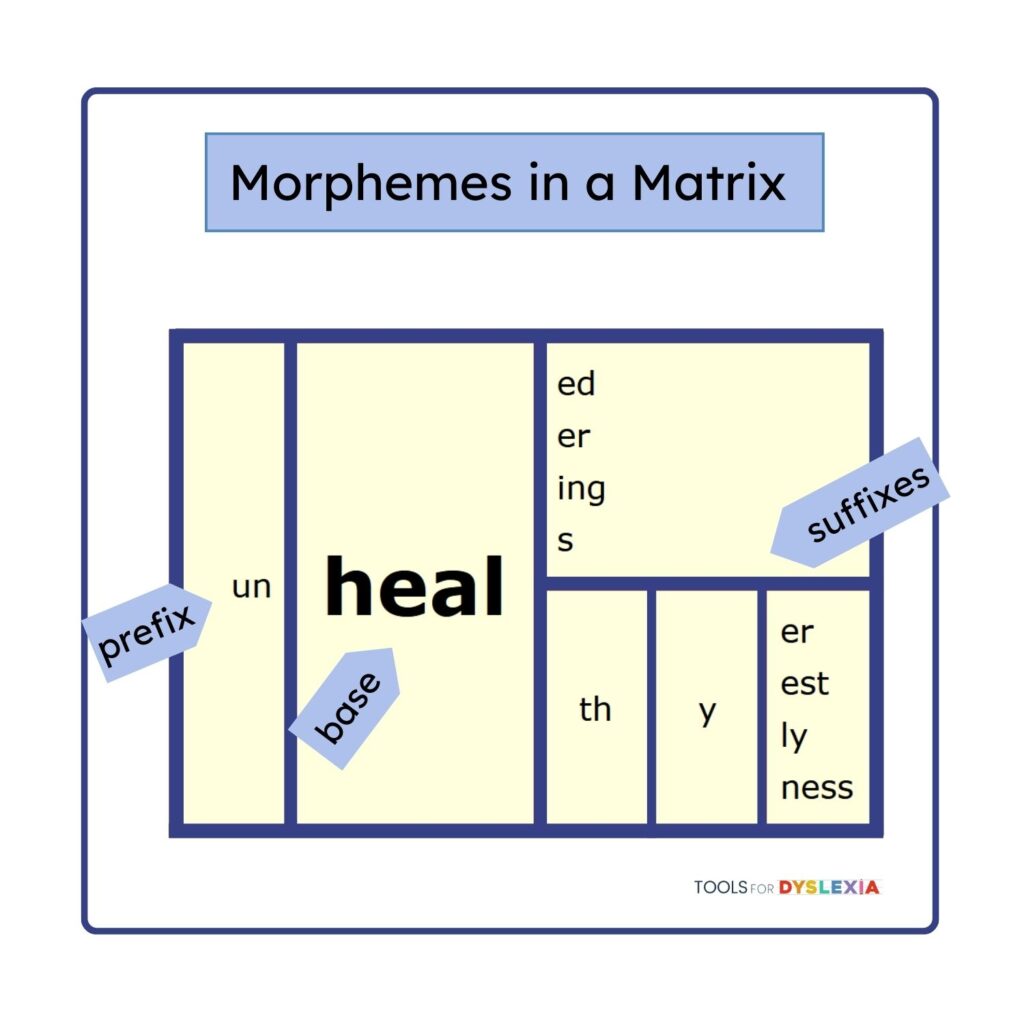
We can create a matrix, work from synthetic word sums (like heal + th + y –> healthy) that combine morphemes to form complete words, or work from analytic word sums like (healthy –> heal + th + y) that separate the morphemes, taking apart the word.
Another question comes when students realize that changes in pronunciation are not changing the spelling.
Phonology
heal, heals, healer, healing, health, healthy, healthier, healthiest, unhealthy
As we create the word family adding affixes, we notice different pronunciations of the base and/or affixes. But the spelling stays the same. The <ea> in heal is pronounced /i:/ (long-E) but is pronounced /ɛ/ (short-E) in health. What other vowel digraph (vowel team) could spell both phonemes?
One 15-year-old student when he found out there was a reason for the <g> in ‘sign’ said, “It’s good to know there’s a reason and these words aren’t spelled crazy just to make my life difficult.”
Student reading improves with their recognition of common prefixes and suffixes. Longer, polysyllabic words become less intimidating. They begin to connect spelling to meaning, which translates into improved comprehension.
Younger and older students appreciate knowing why words are spelled as they are. It builds confidence in their ability to make sense of English, which increases their self-confidence and independence. When something makes sense, it is much easier to remember.

(Image by Oberholster Venita from Pixabay)
Inquiring Minds
Besides the understanding they gain (we gain together), I love their engagement with language and learning. Inquiring minds want to know, right. These students want to know. So do I. Thankfully there is always more to learn using Structured Word Inquiry (SWI) with students. Here’s a Tedx talk by Dr. Bowers and him teaching at the 2025 Reading League Summit.
English makes sense when you can explain it, and we can.
Resources to Get you Started
Books
- Teaching How the Written Word Works by Dr. Peter Bowers
- Structured Word Inquiry, An Implementation Guide for Teachers by Jennifer Constantine & Kara Lee
- Beneath the Surface of Words, What English Spelling Reveals & Why It Matters by Sue Hegland
- Backpocket Words, Sharing the Essence of English Spelling by Gail Portnuff Venable
- Vocabulary & Morphology Using Structured Word Inquiry by Lisa Yambrick Barnett and Katie Squires
Online Tools
- Real Spelling Toolbox, an online subscription resource that provides a wealth of information about how English spelling works.
- Etymonline.com is the go-to for understanding where a spelling came from, its history, and how it evolved to our Modern English spelling. This is a free website, but you can support it here. Here’s the introduction and explanation page that explains terms used in the site.
- Mini-Matrix-Maker lets you create a matrix and Word-Searcher lets you search for specific spellings. Both are created and managed by Neil Ramsden. Read the blog post to learn how to use these important and time-saving tools.
Print and Digital Learning Resources
High School Son Has Tools to Succeed
“My son was in high school when he began working with Laure. We had tried other reading programs and didn’t see the results we hoped for. It was time to try the Barton program. I’m so glad we didn’t give up.
One of my concerns early on was how my son would handle the idea of going back to the basics again as a teenager. This is where I believe Laure made all the difference in the world. She came alongside and encouraged him. He didn’t feel like he was being talked down to or treated like a little kid. That was a big deal for us.
It was exciting to hear my son tell me that he was learning where words came from and how understanding language origins might help him unlock the code. It was also a huge relief to not have to constantly battle with him in this area of learning. He was willing to buckle down and work with Laure in a way that he would not work with me. I was able to regain precious emotional connection with my teenager. That alone was worth every penny.
Laure gave my son a toolbox filled with a unique set of tools and taught him how to use them. He now carries these tools with him everywhere he goes knowing that dyslexia does not have the final word on his success.
We are proud of our son for working hard and thankful that Laure was available to teach him online after her family relocated from Iowa to Nebraska. She has truly made an impact on my family and I wholeheartedly recommend trusting her with your student.” Nichole H.