
RESPECT: A Structured Word Inquiry
$4.50
This Resource has been updated and is available at the Teachers Pay Teachers store: https://www.teacherspayteachers.com/store/tools-for-dyslexia
Description
Your students will learn about morphology and how one base spelling produces so many words we use every day! Spelling, reading and vocabulary are improved when our students learn about morphemes/word parts (prefixes, bases, and suffixes) we use all the time. Whether you’re talking about respect for others, or wanting to get started with morphology with your students, this is a great resource to get your students noticing and looking for morphology. With two games, one for reading and one for spelling, this resource provides multiple ways to engage students in reading and spelling.
You’ll find these in your 26-page PDF download:
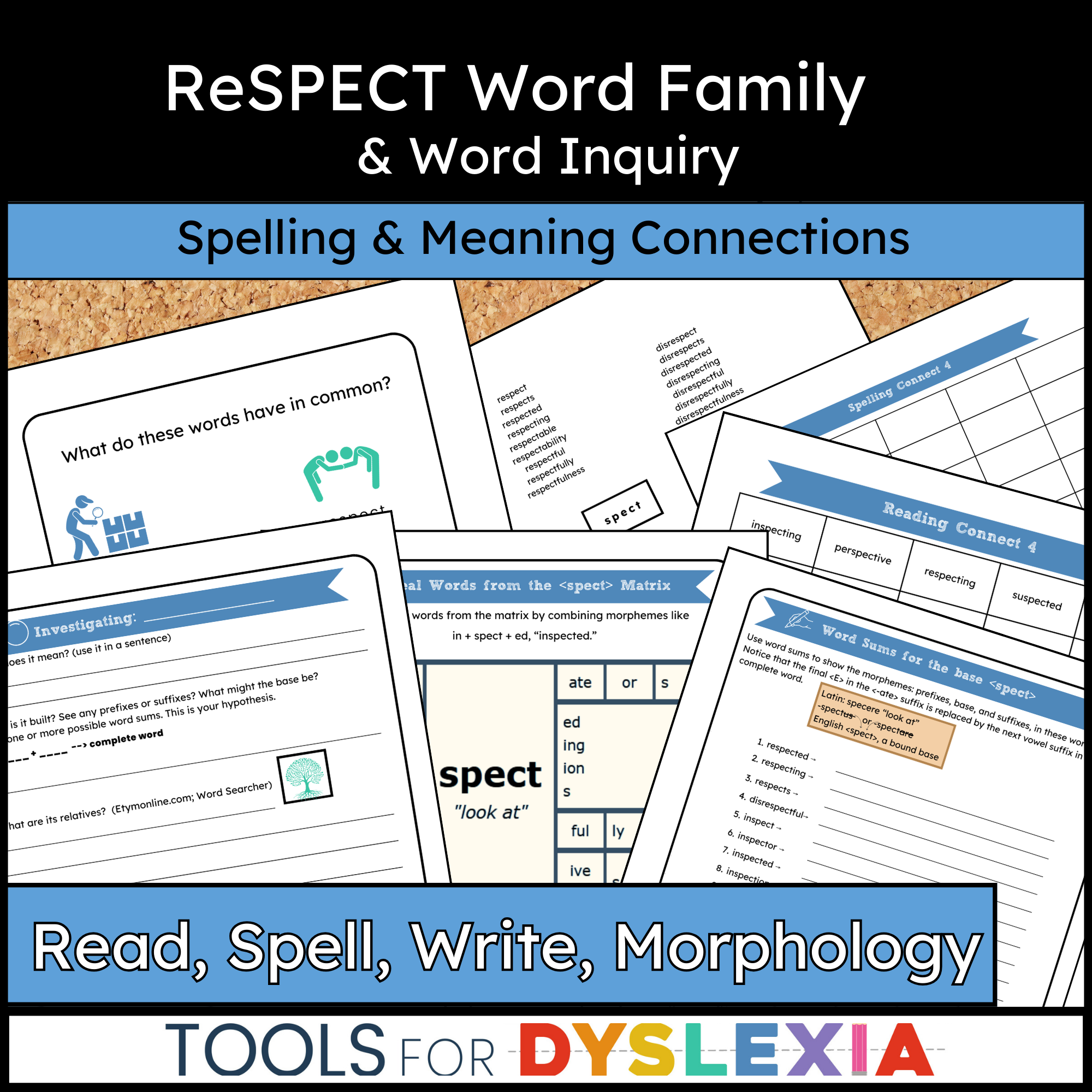
- a discovery graphic for words having the same base spelling as respect
- the structured word inquiry worksheet with the four questions
- 2 pages of word sums (synthetic word sums such as in + spect + or –> inspector & analytic word sums such as inspector –> inspector)
- a blank word sum sheet for any base
- 7 pages of progressively adding a new prefix to the matrix for differentiated instruction
- a matrix with this base for students to write their own word sums
- a matrix with this base for sentence writing using this word family
- explanation of expect (why the S isn’t there) & related words spectacle & spectacular
- a word web student copy and a complete one for you
- reading words connect 4 game
- spelling words connect 4 game
- explanation for the parent, tutor, or teacher about structured word inquiry, using a matrix, writing word sums, using the etymology, etc.
- It’s a resource to teach reading and spelling with this word family that WORKS!
What’s Structured Word Inquiry? It’s a research-based approach to studying a word family and helping students connect the spelling to meaning. Your students will become familiar with common prefixes and suffixes as well as the base of this word family. Once they start noticing these morphemes/word parts, they can’t unsee them!
All students benefit but students with dyslexia especially benefit from seeing how words are put together. It’s like putting the pieces of a Lego creation together. More info about Structured Word Inquiry research (Bowers & Kirby, 2010)
Reading & Spelling Improvement Attention to spelling and morphemes leads to improved reading fluency, reading comprehension, more accurate spelling, and improved writing and vocabulary.
Thanks!